

It starts with a good plan. You pick up a few cans of stain, clear your Saturday and figure the fence will be done by dinner. Then you realize the fence is longer than you remembered, it has two sides, and half of it needs a good scrub before any stain can go on. By late afternoon the plan has turned into a three-weekend project.
Doing the work yourself is certainly possible, and plenty of homeowners do it well. But a fence is one of the larger wood surfaces on a property, and staining it properly is harder than it looks. Here is a fair comparison of the two approaches so you can decide which one suits you.
What a Fence Staining Project Really Involves
The alternative to doing it yourself is hiring for professional fence staining, and the difference between the two often comes down to scope. A fence looks simple from the street, but the actual work includes cleaning, drying, prepping and coating a large surface area.
Consider what is involved. You may have dozens of panels, each with two faces. There are posts, caps, rails and gates, plus the bottom edges close to the ground. Every one of those pieces needs to be clean and dry, and every one needs an even coat. A fence that is 150 feet long and six feet tall has well over a thousand square feet of surface once you count both sides, and that is before you factor in the details.
That is a lot of surface, and every bit of it has to be done properly, or the finish may look uneven or wear out early.
Where DIY Fence Staining Goes Wrong
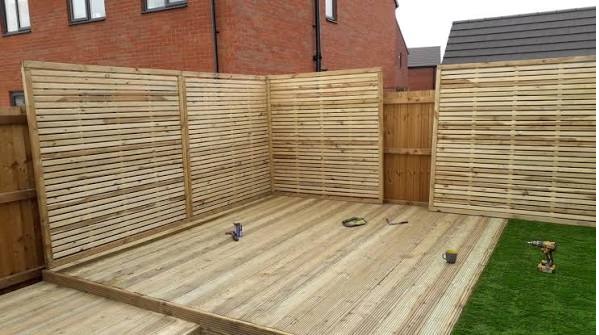
Most DIY problems come from the same handful of mistakes. They are easy to make, especially when you are working against the clock.
- Skipping the cleaning. Stain does not bond well to dirt, mildew or an old failing finish. Skipping this step is one of the most common reasons a new coat peels or looks blotchy.
- Staining damp wood. Wood that has not dried out will not absorb the product properly. Even a fence that looks dry on the surface can hold moisture deeper in. Treated-wood industry guidance notes that drying time is hard to predict, since it depends on how long ago the lumber was treated, sun exposure, temperature and recent weather.
- Lap marks. When stain dries partway before the next pass overlaps it, you get visible streaks. Working in the wrong conditions makes this more likely.
- Drips and runs. Vertical surfaces make drips easy, and they dry into visible lines.
- Overspray and mess. Sprayers cover a lot of ground quickly, but without masking, stain can end up on plants, walkways and neighboring property.
- Wrong product for the wood. A stain that suits one wood or condition may not be right for another.
None of these are signs of carelessness. They are simply the things that go wrong when a job is new to you.
Time, Equipment and Cleanup
What many homeowners underestimate is how much time and equipment the job takes. Cleaning may require a pressure washer, a scrub brush or both. Applying stain efficiently may call for a sprayer, brushes and rollers, and masking materials for plants and nearby surfaces.
Then there is the weather. You need a stretch of dry days, with the right temperature, for the wood to dry and the stain to cure. That can be hard to line up around a work week and family plans.
Cleanup is the last piece. Brushes, sprayers, drop cloths and leftover product all need to be dealt with, and many stains have specific disposal instructions. For a big fence, that is a chore in itself.
What Professionals Bring to the Job
People who stain fences regularly bring a few clear advantages.
- Experience reading the wood. They can judge the condition of the fence, spot problems early and adjust the approach.
- Efficient application. The right tools and a steady technique help finish the job faster and more evenly.
- Consistent results. An experienced crew knows how to avoid lap marks, drips and missed spots.
- Prep and cleanup handled for you. The tedious parts of the project are no longer on your plate.
Here is a quick side-by-side comparison.
| DIY | Professional | |
| Your time | Several days or weekends, depending on size | Minimal, mostly planning and a final walk-through |
| Equipment | You buy or rent it | Provided by the contractor |
| Prep quality | Depends on your experience | Handled by someone who does it often |
| Finish consistency | Can vary, especially on large fences | Generally more consistent |
| Weather risk | You manage it | The contractor schedules around it |
| Cleanup | Your job | Varies by contractor, so confirm |
When DIY Still Makes Sense
Hiring a contractor is not always the right call. If you have a short fence, enjoy the work, own the equipment and have a good stretch of dry weather ahead, staining it yourself can be a satisfying project. Light touch-ups on a single section or a gate are also very doable.
The key is to be honest about the scope. Measure the fence, estimate the surface area, and think about whether you have the time and tools to do the job well. If the answer is yes, go for it. If it feels like too much, that is a sign to get help.
How to Compare Quotes
If you decide to hire someone, get more than one estimate and compare them on more than the bottom line. A clear quote should cover:
- How the fence will be cleaned and prepared
- What type of stain will be used and how many coats
- Whether repairs to loose boards or hardware are included
- How plants, siding and nearby surfaces will be protected
- What happens if weather delays the work
- Whether cleanup is included
If one quote leaves out prep or gives very little detail, ask questions before you decide. Differences in price often come from differences in what is included.
Choose the Approach That Fits Your Fence
A stained fence looks better and holds up better when the job is done carefully. Whether you take it on yourself or bring in help, the most important thing is to give the prep the attention it deserves. Take a look at the size and condition of your fence, be realistic about your time, and pick the path that will leave you with a result you are happy with.